Posts about APLIC Conference

Finding hidden gems in Washington

Many APLIC members are local to the DC area and I am sure they have suggestions on places off the beaten track that are worth checking out.  I have traveled often to DC from the Northeast for business and have stayed to visit the major and some minor attractions of the area.  

I thought it might be fun for the membership (locals and tourists) to share information on some of the un-ordinary and sometimes extra-ordinary sights that APLIC visitors to DC might want to check out when they attend the conference in DC next March. [APLIC 44th Annual Conference in Washington, DC, March 28 – 30, 2011] 

I will plan on posting a new location each week.

The membership will be able to add new places of interest as a comment to my posts or as new blog posts.  New blog posts should use the category: APLIC conference


All the “gems” will be collated for a handout at the conference.

Comments (1)

Amy Tsui: Building capacity in African universities

Following is a report on Amy Tsui’s presentation at the 2010 APLIC conference.

Tsui, a professor in the Department of Population, Family and Reproductive Health at Johns Hopkins Bloomberg School of Public Health, began her talk by saying that APLIC president Claire Twose has been “invaluable” to her research.

Tsui continued talking about research infrastructure, saying it is not often you get money to develop research capacity for the long term – but she got just that from the Bill and Melinda Gates Foundation. Tsui is director of the Bill and Melinda Gates Institute for Population and Reproductive Health, which works with African universities to develop research and training programs.

» Continue reading “Amy Tsui: Building capacity in African universities”

Comments (1)

If you build it, will they log in ?

This is the first of a series of posts reporting on talks given at the APLIC Annual Meeting.

Presenters : Allison Burns, Family Health International; Tara Murray, Population Research Institute, Penn State University; Kay Willson, Futures Group

Put two information professionals in a room and you know that eventually they will begin trading stories about what may be the biggest headache we face every day : getting our beloved researchers to help us help them.

Allison Burns, Tara Murray, and Kay Willson gave three perspectives on this vexing issue, looking at some useful tools, how the tools fit the need, and getting participation.

Family Health International was using email and an intranet for collaboration among 2,500 staff in 55 countries worldwide. Problems arose from “email fatigue” and some email policies that restricted what could be shared, as well as accessibility to the intranet on the part of staff in infrastructure-challenged environments. Allison Burns finally settled on a Wiki installation (Confluence) that provided some impressive functionality that could be accessed anywhere an internet connection was available. It was inexpensive, flexible, and included an alert feature and interactivity.

Specifically, it allowed library staff to easily edit and upload documents and to create documents using a rich-text editor. For the users, anyone within the organization who wished to track new documents being uploaded could simply put a watch on the pages that interested them and, of course, it supplemented other forms of communication.

At the Population Research Institute, Tara Murray was working with data archives and a range of users who needed varying degrees of access. Some users would need access simply to the data archive; another group would need access to confidential datasets or other restricted information; finally, a dedicated area for staff collaboration was desired. Her audience comprised students, faculty, peer researchers not at PRI, and staff – all with varying degrees of computer literacy.

Tara implemented an open source web server (Plone) to manage roles and access to the data. It provided simplified search, granular definition of user permissions and workflow, and a way to wrangle the numerous gatekeepers and their priorities. Plone is a content management system, and the interface for creating new documents is easy to learn and not too different from what most MS Office savvy individuals are used to. One benefit of having a staff-dedicated area ended up being greater ease collating staff meeting notes, which are often taken by a different person at each meeting.

Kay Willson has been working for one or another version of Futures Group for many years. Her recent task has been to roll out a Sharepoint collaboration tool. During a previous Futures Group incarnation, a Knowledge Management initiative resulted in an implementation of Sharepoint, mostly to support communities and repositories. Because most users did not enter metadata the result was a multiplicity of sites with no common template – a kind of “Sharepoint for silos,” as it were. On top of that, there was a preconceived idea that Sharepoint was hard to use. “You can’t just tell them it’s easy; you have to stand there and make them do the process (like uploading a file) – that’s the only way it sinks in,” Kay noted.

Kay drew on the book Influencer : The power to change anything* for tactics to create real change. There is a matrix of six strategies for creating influence. The key is to “overwhelm” by implementing at least four of the strategies: 1) on the personal level, make the undesirable desirable and push your limits; 2) on the social level, harness peer pressure and find safety in numbers (of others supporting the cause); 3) on a structural level, design rewards and demand accountability and make whatever alterations to the environment that might encourage the new behavior.

So: Did they log in ? Results are mixed. Kay reported decent results, especially because of strong support from a key stakeholder; Tara reported improvements but no revolution; and Allison is still waiting to find out.


* Influencer: The Power to Change Anything, by Kerry Patterson, Joseph Grenny, David Maxfield, Ron McMillan, and Al Switzler (McGraw-Hill 2007, 288pp).

Leave a Comment

Not a conventional banquet

APLIC doesn’t do things as others do – let’s be clear about that.

This was my first conference and, truth to tell, my heart was not beating especially fast knowing I would be spending five days in Dallas, Texas. Preconceived ideas, you see.

So – conference hotel, the usual story: big spaces without intimacy and a maze of meeting rooms spread out on two or three levels. You spend the first day just figuring things out. At some point you forget about the environment and remember that the meeting is about people. Folks who are doing something like you do and who may have some insights. Folks who end up being fun to know, too.

At any rate, the 2010 planning group hit a home run with this year’s banquet.

» Continue reading “Not a conventional banquet”

Leave a Comment

APLIC 2010 conference a success

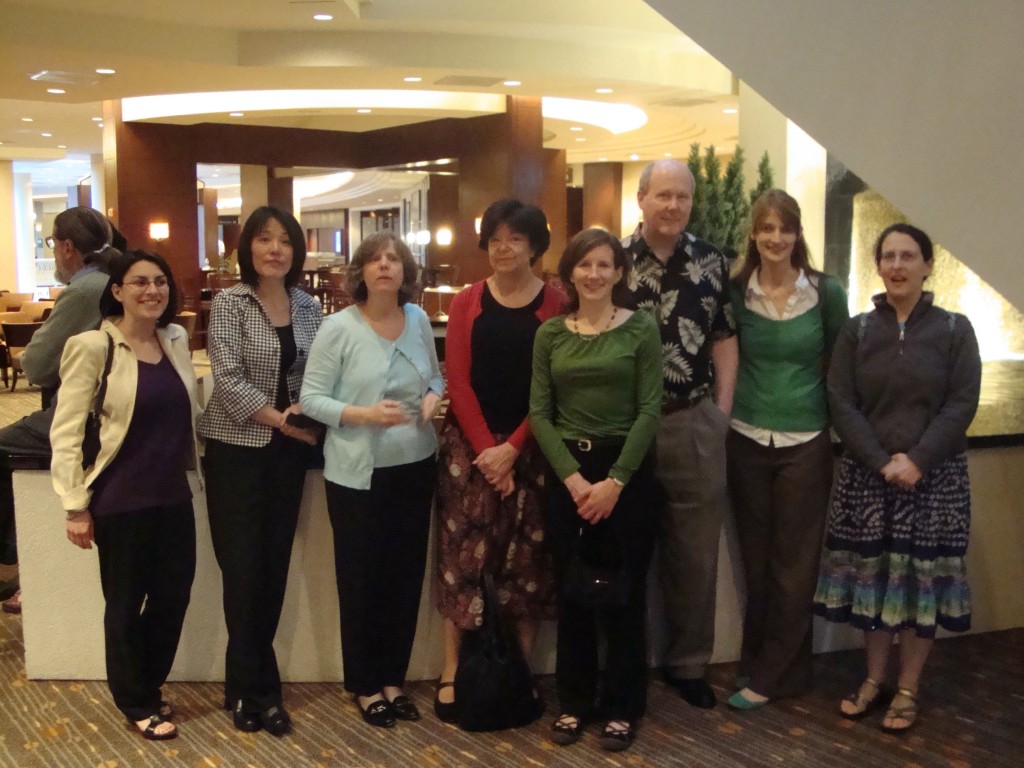
APLIC held its 43rd annual conference in Dallas last week. The conference was small and allowed for a lot of interaction with speakers and between attendees. In the coming weeks, we’ll be posting presentation slides, reports from attendees, and business meeting minutes. In the meantime, here is a photo of conference attendees waiting for a ride to the APLIC annual banquet (courtesy of Elana Broch).

APLIC 2010 conference attendees

Leave a Comment

Conference mail-in registration extended to March 15

Join us in Dallas for Population Information Roundup: Tools, Experts, and Networks – including what promises to be a valuable introduction to Census 2010, as well as a presentation from Amy Tsui, the director of the Bill and Melinda Gates Institute for Population and Reproductive Health and sessions on DHS tools, immigration trends, and tools to support effective collaboration across organizations. Plus sample a unique twist on local cuisine during our banquet at one of Dallas premiere restaurants: Local.

Register today – mail-in registration closes March 15!

Leave a Comment

Don’t forget to register for APLIC’s 2010 conference

The deadline for mail in registration is March 1. Check the conference web page for a preview of the program and a link to the registration form.

Leave a Comment

Join us for APLIC’s 43rd Annual Conference, Dallas Hyatt Regency, April 12-14th

APLIC is pleased to be presenting its 43rd Annual conference this year in Dallas, TX:

Where: Dallas Hyatt Regency
When: April 12-14th, 2010

Join us for: Population Information Roundup: Tools, Experts, and Networks including what promises to be a valuable introduction to Census 2010 as well as sessions on DHS tools, immigration trends, and tools to support effective collaboration across organizations. And sample a unique twist on local cuisine during our banquet at one of Dallas premiere restaurants: Local: www.localdallas.com

Mail in registration is due by March 1st.

More information and the registration form available here:
http://www.aplici.org/conferences/43rd-annual-conference/

See you in Dallas!

Claire Twose
APLIC President

http://www.aplici.org/conferences/43rd-annual-conference/

Leave a Comment

New blog: All Things Census

All Things Census is a new blog from the Pew Research Center dedicated to “census methodology, findings and resources.”

The 2010 Census kicks off next week in a remote village in Alaska, but most Americans will receive their Census forms in March.

APLIC will present a session on the 2010 Census at our annual conference in April.

Leave a Comment

Celebrate National Library Week during our APLIC conference in Dallas

Libraries are the heart of their communities. National Library Week 2010 (April 11-17) will be celebrated with the theme, “Communities thrive @ your library.”

National Library Week is an annual celebration of the contributions of our nation’s libraries and librarians. All types of libraries – school, public, academic and special – participate.

Check out the free promotional tools  for new ways to promote the message of National Library Week.

Leave a Comment